

Glute strength matters even if you don't have hip pain

Ok….I am going to run you through health insurance. Main terms, procedures, why you or your doctor might not know how much you will owe for a service and hopefully make things clearer for you as the consumer. I am going to use United Healthcare as an example here… this is not to say they are better or worse than any other plan, just felt like using them.

Terms:
Provider: This is the healthcare professional you are seeing. Physical Therapist, Doctor, Surgeon, etc.
Copay: This is a fixed dollar amount that you may owe towards your care. This is dictated by your insurance company, not your provider.
Co-insurance: This is a percentage of the allowable amount that you may owe for your care. This is determined by your insurance company, not your provider.
Allowable: This is the contracted rate between your provider and the insurance company. This is the amount that insurance companies are gradually reducing over time. This is why you are getting less time with your provider in general. This is determined by your insurance company, not your provider)
ICD10 code: This is the diagnostic code that your physician, PT, provider uses to describe your reason for being at the office. For example: one of the codes for low back pain is M54.9. But there are 70,000 diagnostic codes. Even this one W61.62XD…struck by a duck, subsequent encounter. Your insurance company can deem any code not valid…and deny payment. Unsure why.
CPT code: This is the treatment code that a physician will use. There are over 11,000 of these.
Deductible: This is a dollar amount, let's call it $3000 for example, that you have to meet before your health insurance will kick in at all.
Max out of pocket: This is generally a higher number than your deductible, let’s go with $5000 for our example. This is the maximum you could be responsible for in a given year. Once you spend this amount on healthcare using your insurance, you will not be responsible for anything else that year.
Authorization: This is something that generally your provider has to get prior to treating you. Yes, your provider has to get permission from your insurance company for many procedures. These are generally always put in electronically….and here’s the kicker, the vast majority of them are not approved by a human, just a computer somewhere making decisions about your health.
Referral, prescription, script: All words to describe a piece of paper that you need prior to seeking treatment from a provider. Some services require these, some don’t. This is dictated either by state law or by your insurance plan.
HMO, PPO, EPO: These are all different types of plans within your insurance company. Typically HMO are heavily restricted on who you can see and everything has to be managed by your primary care physician. PPO and EPO are more flexible plans.
Subsidiary or management organization: This is a third party company that manages your care (payment for care) and works for the insurance company itself. With regards to United Healthcare and physical therapy, it is a company called Optum. This company also manages pharmacy benefits as well. Optum is owned by United Healthcare.
Medicare advantage plan: This is a plan that is run or managed by a commercial company (United Healthcare for example) but medicare pays them a bunch of money to then manage your care and pay your providers.
Explanation of Benefits (EOB): This is the paper you get in the mail that says “this is not a bill.” It is a document from your insurance that tells you the allowable amount that your insurance will pay, and what portion of that amount you owe as the individual getting care.
Fee schedule: This is what the insurance will pay based on codes billed. All codes are different, and all codes are for different services.
Good faith estimate: This is an estimate that the office will give you for a given service.
Ok, now I will give you a real world example of how this whole thing works. I will use made up numbers because it is a violation of my contract with United to discuss real numbers.
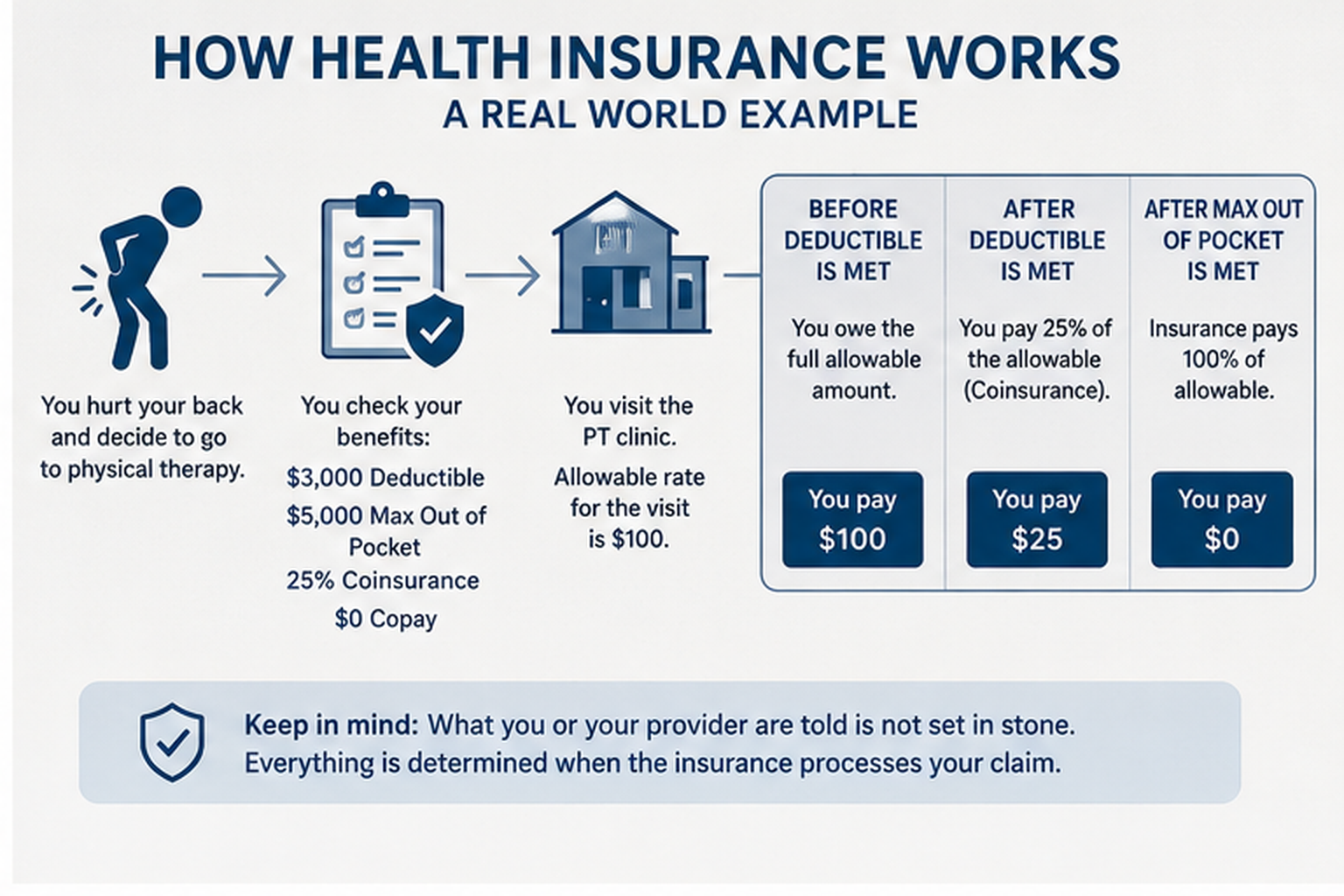
Ok, you hurt your back and want to go to PT. You have a United Healthcare Commercial plan that has a $3000 deductible and a $5000 max out of pocket. Your plan has a co-insurance of 25%, but no copay. You learned all of this because you either called and got your benefits or the office that you are going to got them for you.
An important note here. What the insurance quotes you or your provider is not set in stone. Everything is dictated when they actually process your claim. That's why there is always a disclaimer that everything will be “dictated by your plan.” You also learned that you don’t need a referral. So you come to PT and have a pleasant visit. Your office knows that the allowable rate for a PT visit is $100. Now, this is easy because it is a flat rate regardless of what is billed to your insurance. This isn’t the case with all insurances. Some are code based, not flat rate. Which means it depends on what the therapist actually does. Often this isn’t documented until after you leave the visit, so the front office has no idea what the cost will be. The therapist doesn’t either, unfortunately. So maybe this visit will cost $60, or it could be $103.54. It is hard to tell as it is entirely based on what the insurance says you owe.
Ok, back to the United example. Because it is visit-based and you haven’t met your $3000 deductible, you owe the full allowable amount of $100. You owe the allowable amount until you have spent $3000 towards your deductible. Now... not all health care expenses get applied to your deductible. This is spelled out in your lengthy benefits package that you have access to, which is not a confusing document at all (read that last statement with loads of sarcasm).
So unfortunately something bad happened to you and you met your deductible... yeah, now insurance kicks in. So you have a 25% coinsurance. In this case you would then owe $25 towards each visit, vs the total $100. Since the allowable is $100, 25% coinsurance is $25. You will owe co-insurances or copays until you have spent $5000. After that your insurance will be responsible for all of the care you receive. Hopefully this helps.
Want to discuss more about insurnace? Give us a ring or drop an email, we’d be happy to have a chat.

Why Glute Strength Matters Even If You Don't Have Hip Pain

Does your low Back MRI matter?
Your back MRI may be a waste of money, and may not change your treatment.

Do Your Glutes Need Activating?
What's the skinny on this, or is it a whopper?